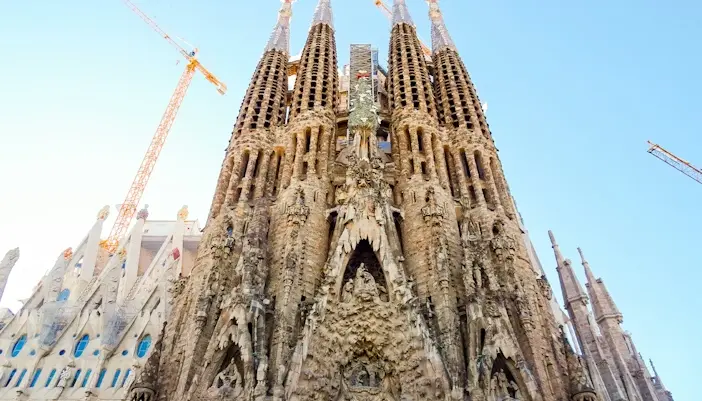
The Sagrada Familia architecture stands as one of the most extraordinary expressions of creativity, spirituality and innovation in the history of architecture. More than a basilica, it represents Antoni Gaudí’s vision of a living monument, deeply rooted in faith, nature and symbolism. Rising above the urban fabric of Barcelona, the Sagrada Familia has become one of the most important Barcelona heritage sites, shaping how the city is perceived worldwide.
Understanding this monument requires more than admiration. Its complexity, meaning and architectural solutions reveal themselves fully when explored in context, making the Sagrada Familia visit a profound cultural experience.
The origins of the Sagrada Familia
A project born from devotion
The origins of the Sagrada Familia date back to 1882, when the project was conceived as a religious temple funded entirely by donations. Initially assigned to architect Francisco de Paula del Villar, the project changed dramatically when Antoni Gaudí took over in 1883.
From that moment, Gaudí transformed the basilica into an ambitious synthesis of art, faith and architecture, redefining Barcelona architecture for generations to come.
Gaudí’s lifelong dedication
Gaudí devoted the last years of his life almost exclusively to the Sagrada Familia. He lived modestly, worked obsessively and accepted that the building would not be completed during his lifetime. His intention was to create a timeless work, built slowly and carefully, allowing future generations to continue his vision.
This long-term approach explains why the basilica remains under construction today, embodying Gaudí’s belief that architecture should transcend individual authorship.
Antoni Gaudí’s architectural vision
Nature as divine inspiration
One of the defining elements of Sagrada Familia architecture is Gaudí’s use of nature as a structural and symbolic reference. Columns branch like trees, vaults resemble forest canopies and light filters through stained glass as if through leaves.
Gaudí believed that nature was the ultimate expression of divine order, and he translated its logic into architectural form, creating spaces that feel organic, harmonious and alive.
Innovation beyond conventional design
Gaudí’s approach was radically innovative. He abandoned traditional Gothic structures and developed new systems based on geometry, gravity and natural balance. Using models made of strings and weights, he calculated forces intuitively, decades before modern engineering tools existed.
These techniques place the Sagrada Familia among the most advanced examples of Barcelona architecture, combining artistry with structural intelligence.
The symbolism behind the basilica
Façades as narratives
Each façade of the Sagrada Familia tells a different story. The Nativity Façade celebrates life and creation with rich ornamentation, while the Passion Façade presents a stark, emotional portrayal of suffering and sacrifice. The Glory Façade, still under construction, represents humanity’s path toward God.
Together, these façades transform the building into a monumental narrative carved in stone, reinforcing its role as a spiritual and cultural landmark.
Light as a spiritual language
Inside the basilica, light becomes a central element. Carefully designed stained-glass windows bathe the interior in changing colours throughout the day, creating a dynamic atmosphere that enhances contemplation.
This mastery of light elevates the Sagrada Familia visit from sightseeing to a deeply emotional and reflective experience.
The Sagrada Familia as a Barcelona heritage site
Cultural and architectural significance
The Sagrada Familia is not only a religious monument but also a cornerstone of Barcelona heritage sites. It reflects the city’s modernist movement, its creative spirit and its ability to blend tradition with innovation.
Declared a UNESCO World Heritage Site, the basilica stands as a testament to Barcelona’s cultural ambition and architectural excellence.
Influence on modern architecture
Gaudí’s solutions continue to inspire contemporary architects worldwide. His emphasis on organic structures, sustainability and human-centred spaces resonates strongly with modern architectural values.
As a result, the Sagrada Familia remains a reference point in discussions about the future of architecture.
Experiencing the Sagrada Familia through guided cultural visits
Why context matters
While the Sagrada Familia is visually impressive, its deeper meaning often goes unnoticed without proper explanation. Understanding Gaudí’s symbolism, construction techniques and historical context enriches the experience significantly.
This is why guided cultural experiences offer a more meaningful way to explore the basilica.
Guided visits as immersive experiences
A well-designed Sagrada Familia visit allows visitors to connect architecture, history and spirituality. Expert guides provide insights that transform observation into understanding, revealing details hidden in plain sight.
For travelers seeking authentic and educational experiences, curated tours such as those offered through
https://www.allaboutgauditours.com/
help bridge the gap between monument and meaning, offering a deeper connection to Barcelona’s architectural heritage.
The ongoing construction and its meaning today
A living monument
Unlike completed historic buildings, the Sagrada Familia continues to evolve. Modern architects and craftsmen work with advanced technology while respecting Gaudí’s original vision, ensuring continuity between past and present.
This process reinforces the idea of the basilica as a living work of art.
A symbol of Barcelona’s identity
Today, the Sagrada Familia stands as a powerful symbol of Barcelona’s identity. It represents creativity, perseverance and cultural pride, attracting visitors from around the world who seek meaningful cultural experiences.
The Sagrada Familia architecture is far more than an architectural masterpiece. It is a spiritual narrative, a technological achievement and a cornerstone of Barcelona heritage sites. Through Antoni Gaudí’s vision, the basilica continues to shape the city’s cultural landscape, offering visitors an experience that goes beyond aesthetics.
A guided exploration allows this monument to be fully understood, transforming a visit into a lasting cultural journey.
No responses yet